
Ecologies of Labour
Network
Who are we?
The Ecologies of Labour Network began as a group of academics, policy analysts and activists coming together for a symposium on the same theme organised at the Nottingham Trent University, UK in 2023.
The network comprises of people passionate about a future of labour placed within dignity, environmental concerns, and justice.
Our members are positioned across various fields and stages in their career. As a socially and spatially diverse group we live across various regions such as India, the UK, Brazil, Netherlands, Indonesia, Finland, Argentina, Spain, Portugal, the US, and Germany, with more joining in solidarity.
Stay tuned for our Seminar Series and other news regarding our collaborative work.
Seminar Series
Agricultural labour temporalities: exploitation, care, and ecological regeneration
THURSDAY
15 OCTOBER 2026
07:00 Brasil
11:00 UK
15:30 India
Agricultural labour is organised through temporal regimes that shape not only production processes but also social reproduction and environmental regeneration. This seminar compares intensive agricultural enclaves integrated into global supply chains with agroecological farming systems oriented towards care, ecological regeneration, and territorial embeddedness. It explores how different ways of organising time affect workers’ lives, gender relations, and agrifood systems. Drawing on research from Southern Europe and feminist social reproduction perspectives, the presentation examines how the just-in-time rhythms, flexibility, and labour intensification characteristic of agricultural enclaves often conflict with care responsibilities and disproportionately affect women, intensifying gendered exploitation, inequality, and vulnerability. In contrast, agroecological farming may create temporalities more closely aligned with ecological cycles and the reproduction of life. Yet these systems also face challenges related to workload, labour intensity, and the unequal distribution of reproductive labour. By bringing together debates on labour, social reproduction, and environmental sustainability, the presentation argues that labour temporalities are a key dimension of the political ecology of agrifood systems. The organisation of time in agricultural work shapes not only who produces food and under what conditions, but also the capacity of agrifood systems to sustain human wellbeing, gender justice, and ecological regeneration.
Bio:
Rita Calvário is a researcher at DINAMIA’CET-Iscte, the Centre for the Study of Socioeconomic Change and Territory at Iscte - University Institute of Lisbon. An interdisciplinary social scientist specialising in rural sociology and political ecology, her research focuses on rural social movements, agrarian transformations, food system transitions, and the power relations that shape agrifood systems, with a particular focus on Southern Europe.
.png)
Seminar Series
Designing the Just Transition? Design Politics, Labor and Joyful Worldmaking for Post-Carbon and Post Fascist Futures
THURSDAY
24 SEPTEMBER 2026
09:00 Brasil
13:00 UK
17:30 India
Abstract
Over the last decade discussions of labor-environmentalism and labor/ecologies have offered one of the most importance spaces for debating how we might organize, struggle and fight for just post carbon transitions that serve the interests of working people. In this talk, Damian White draws from his new book, co-written with the landscape architecture, Nicholas Pevzner, Designing the Just Transition (Bloomsbury, 2026) to explore what the tangled and often forgotten labor and environmental histories and contemporary labor/ecology struggles occurring in design, planning, and architecture might contribute to just transitions. Design is not to be trusted. However, this book argues that post-carbon futures are not simply going to emerge through protest and policy shifts alone. Rather, just transitions will also have to be materialized and built, coded and created, imagined, desired, and enacted on an ongoing basis by many hands and many skills. If we take this proposition seriously, and the broader proposition that the unfolding climate crisis now irreducibly throws us into a politics of ongoing worldmaking, such an observation raises critical further questions. In this talk, we consider how climate-design discussions might be rendered more complex – and perhaps move us beyond tired degrowth/ecomodern binaries - by engaging with the distributional issues, uneven geographies and messy trade-offs revealed by the social science of just transitions. We consider how a focus on design-labor might expand critical social science consideration of the range of creative material agencies that will be required to enact just transitions on a warmer, more restless, and more turbulent planet. Finally, we consider how much a climate-labor politics that celebrates the creativity of labor, the possibilities for collective design and joyful sustainable worldmaking might provide tools to fight back against surging populist Right and neo-fascist currents, forces which as Richard Seymour (2024) observes, increasingly feed on grievance, resentment and disenchantment and offer working people the transgressive promise of deriving pleasure, excitement, thrills and validation from the suffering of others.
Damian White is a Professor of Social Theory and Environmental Studies at the Rhode Island School of Design and author of Bookchin - A Critical Appraisal (Pluto, 2008), Environments, Nature and Social Theory -with Alan Rudy and Brian Gareau- (Palgrave, 2016); the editor of Technonatures and Autonomy, Solidarity, Possibility - The Colin Ward Reader (with Chris Wilbert) and author of Designing the Just Transition - with Nicholas Pevzner (Bloomsbury, 2026).
.png)
Seminar Series
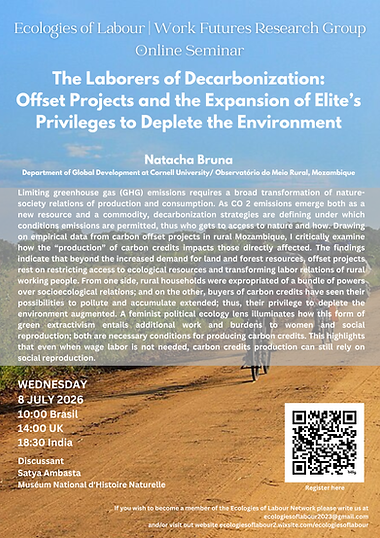
The Laborers of Decarbonization: Offset Projects and the Expansion of Elite’s Privileges to Deplete the Environment
WEDNESDAY
8 JULY 2026
10:00 Brasil
14:00 UK
18:30 India
Abstract
Limiting greenhouse gas (GHG) emissions requires a broad transformation of nature-society relations of production and consumption. As CO 2 emissions emerge both as a new resource and a commodity, decarbonization strategies are defining under which conditions emissions are permitted, thus who gets to access to nature and how. Drawing on empirical data from carbon offset projects in rural Mozambique, I critically examine how the “production” of carbon credits impacts those directly affected. The findings indicate that beyond the increased demand for land and forest resources, offset projects rest on restricting access to ecological resources and transforming labor relations of rural working people. From one side, rural households were expropriated of a bundle of powers over socioecological relations; and on the other, buyers of carbon credits have seen their possibilities to pollute and accumulate extended; thus, their privilege to deplete the environment augmented. A feminist political ecology lens illuminates how this form of green extractivism entails additional work and burdens to women and social reproduction; both are necessary conditions for producing carbon credits. This highlights that even when wage labor is not needed, carbon credits production can still rely on social
reproduction.
Natacha Bruna is a Postdoctoral Associate at the Department of Global Development at Cornell University. Ph.D. in Development Studies within the Political Ecology research group at the International Institute of Social Studies (ISS, The Hague) in the Erasmus University Rotterdam. Worked as a researcher for 12 years and currently associate researcher of the – Observatório do Meio Rural (OMR) in Mozambique. She is also an associate editor of the Feminist Africa journal.
.png)
Seminar Series
Social Ecology and the Solidarity Economy
WEDNESDAY
3 JUNE, 2026
10:00 USA
11:00 Brasil
15:00 UK
19:30 India
This seminar introduces social ecology, a radical and holistic framework for thinking about the relationship between nature and society, emphasizing the crucial role of freedom and democracy. Finley's book "Practicing Social Ecology: From Bookchin to Rojava and Beyond" explores the history, core ideas, and practice of social ecology, from its conception by the late philosopher Murray Bookchin to its implementation today in Northern Syria's Rojava region. In this talk, she will hone in on how social ecology is relevant to the future of labor and ongoing efforts to build a social and solidarity economy.
Dr. Eleanor Finley is an activist-ethnographer and the author of "Practicing Social Ecology: From Bookchin to Rojava and Beyond." She has a PhD in Anthropology from the University of Massachusetts, Amherst and is a currently board member at the Institute for Social Ecology as well as a member of the Virginia Solidarity Economy Network.

Seminar Series
Understanding Rural Transitions within Green Capitalism and the Role of Scholar Activist
THURSDAY
12 February, 2026
08:00 Brasil
11:00 UK
16:30 India
Politically marginalised rural communities are increasingly disadvantaged by a global, extractivist model of rural development shaped by dominant corporate interests and transnational multi-national companies. In this autoethnographic reflection, I examine the discrepancies between the sustainable imaginaries promoted by the European “green” transition and the realities of green grabbing and top-down extractive interventions experienced by rural communities, including my own in southern Portugal. I also consider questions of agency and positionality as a scholar-activist operating within a liberalised academic setting and explore the complexities inherent in living, resisting, and conducting research within a green sacrifice zone. This seminar extends an open invitation to those interested in collaboratively debating opportunities for emancipation for rural populations facing enclosure, privatisation, and the export of endemic resources under technocratic, capitalist, and growth-oriented development agendas. Together, we will reflect on community financing models, tools, and knowledge-generation mechanisms that may empower individuals who wish to remain in rural areas and resist exploitation and exclusion.
Kaya Schwemmlein (PhD) is a lecturer and early-stage researcher in the Socio-Ecological Transition group at the Centre for Ecology, Evolution, and Environmental Changes at the Faculty of Sciences of the University of Lisbon. Her research focuses on the political ecology of low-carbon and post-growth futures, critical agrarian studies, and food sovereignty. She is also an activist with “Juntos pelo Cercal,” “Protege Alentejo,” and the “TAMLA” collective, where she critiques green growth-oriented development.

Seminar Series
Labour across the energy continuum: Foregrounding community care and social infrastructure
WEDNESDAY
10 December, 2025
10:00 Brasil
14:00 UK
18:30 India
Flows of energy in society and space are shaped by human labour, in ways that are often poorly recognized in relation to the global climate challenge, and the ongoing energy crisis. In this talk, I synthesize and interrogate existing scholarship on the relationship between energy and labour across different spatial and temporal contexts, to reveal the overlapping networks that bind energy workers, consumers and producers. Drawing upon geographical, feminist, social practice and political ecology insights, I propose a research agenda centring on the role of social reproduction and community care in shaping the circulation of energy across cities and regions.
Stefan Bouzarovski is a Professor of Human Geography at the University of Manchester, where he directs the People, Place and Energy Research Centre. His research and policy interests focus on the relationships between energy transitions, social infrastructure and spatial inequality. He is a Co-Investigator in two research centres on these topics – the Energy Demand Research Centre (EDRC), and the Centre for Joined-Up Sustainability Transformations (JUST).

Seminar Series
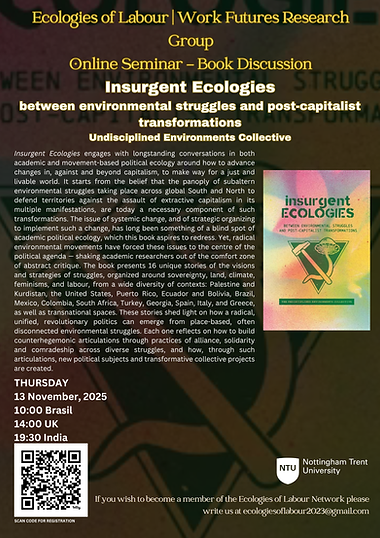
Insurgent Ecologies: between environmental struggles and post-capitalist transformations (Book Discussion)
Thursday
13 November, 2025
10:00 Brasil
14:00 UK
19:30 India
"Insurgent Ecologies" engages with longstanding conversations in both academic and movement-based political ecology around how to advance changes in, against and beyond capitalism, to make way for a just and livable world. It starts from the belief that the panoply of subaltern environmental struggles taking place across global South and North to defend territories against the assault of extractive capitalism in its multiple manifestations, are today a necessary component of such transformations. The issue of systemic change, and of strategic organizing to implement such a change, has long been something of a blind spot of academic political ecology, which this book aspires to redress. Yet, radical environmental movements have forced these issues to the centre of the political agenda — shaking academic researchers out of the comfort zone of abstract critique. The book presents 16 unique stories of the visions and strategies of struggles, organized around sovereignty, land, climate, feminisms, and labour, from a wide diversity of contexts: Palestine and Kurdistan, the United States, Puerto Rico, Ecuador and Bolivia, Brazil, Mexico, Colombia, South Africa, Turkey, Georgia, Spain, Italy, and Greece, as well as transnational spaces. These stories shed light on how a radical, unified, revolutionary politics can emerge from place-based, often disconnected environmental struggles. Each one reflects on how to build counterhegemonic articulations through practices of alliance, solidarity and comradeship across diverse struggles, and how, through such articulations, new political subjects and transformative collective projects are created
Seminar Series
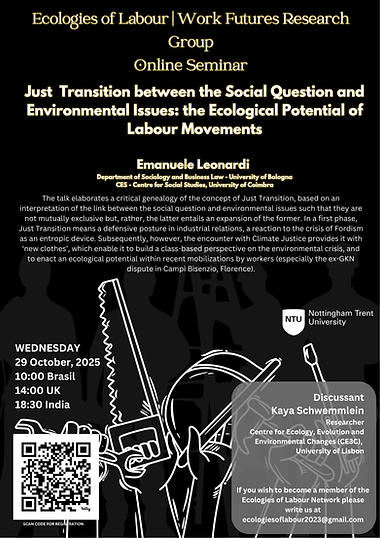
Just Transition between the Social Question and Environmental Issues: the Ecological Potential of Labour Movements
Wednesday
29 October, 2025
10:00 Brasil
14:00 UK
17:30 India
The talk elaborates a critical genealogy of the concept of Just Transition, based on an interpretation of the link between the social question and environmental issues such that they are not mutually exclusive but, rather, the latter entails an expansion of the former. In a first phase, Just Transition means a defensive posture in industrial relations, a reaction to the crisis of Fordism as an entropic device. Subsequently, however, the encounter with Climate Justice provides it with ‘new clothes’, which enable it to build a class-based perspective on the environmental crisis, and to enact an ecological potential within recent mobilizations by workers (especially the ex-GKN dispute in Campi Bisenzio, Florence). Keywords: Climate justice, Just transition, Transnational climate governance
Seminar Series
Humans Disguised as Robots: capitalism’s contradictions, the value of social reproduction and call centre labour in Portugal.
THURSDAY
12 MAY, 2025
10:00 Brasil
14:00 UK
18:30 India
Abstract:
This article draws upon insights from Marxian political-economic anthropology and social reproduction theory to examine one of the fastest-growing sectors of the global service economy in the 20th and 21st centuries: the call centre sector. Through an extensive case study of the Portuguese call centre sector, the article explores the co-constitutive historical and ideological dynamics produced by, and productive of, different national paths of capitalist accumulation and intergenerational reproductive struggles expressed as normative livelihood improvement projects. It examines how these dynamics significantly shape the nature of value-generating processes in the call centre labour process. In contrast with prominent tendencies in the call centre scholarship, it is argued that human agency is a source of value, not despite but because of its social and moral embeddedness in historical realities of kin, class and generation, and national economic transitions. The perception of call centre operators as robots rather than humans stems from the scholarship's reluctance to recognise the operators' agency, meanings, and intentions—elements that impact the processes of value generation in the workplace and are intricately defined by their relational positions concerning structures of exploitation and historically embedded conditions of devaluation, as well as their aspirations for valued projects of becoming.
Bio:
Patrícia Alves de Matos is an economic anthropologist trained in Lisbon and London. She is currently a Senior Researcher at CRIA-ISCTE-IUL with the project "Everyday Worlds of Welfare: A Comparative Study of Human Needs, Livelihood Sustainability and Social Policy in Southern Europe", funded by the Portuguese Foundation for Science and Technology. This project proposes a comparative bottom-up approach to human welfare calculus and welfare sustainability, focusing on the theoretical relevance of the concept of "everyday worlds of welfare" (EWW). Patrícia Alves de Matos is also an Auxiliary Invited Lecturer in the Department of Anthropology at FCSH/New University of Lisbon. Her research interests include neoliberalism, precarity and labour; gender, body politics and social reproduction; austerity welfare, needs and moralities of distribution. Manchester University Press published her monograph, "Disciplined Agency: Neoliberal Precarity, Generational Dispossession and Call Centre Labour in Portugal", in July 2020.

Seminar Series
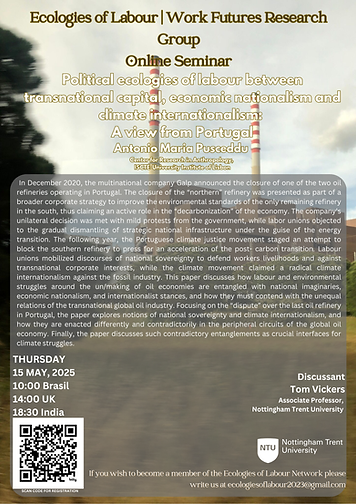
Political ecologies of labour between transnational capital, economic nationalism and climate internationalism:
A view from Portugal
THURSDAY
15 MAY, 2025
10:00 Brasil
14:00 UK
18:30 India
In December 2020, the multinational company Galp announced the closure of one of the two oil refineries operating in Portugal. The closure of the “northern” refinery was presented as part of a broader corporate strategy to improve the environmental standards of the only remaining refinery in the south, thus claiming an active role in the “decarbonization” of the economy. The company’s unilateral decision was met with mild protests from the government, while labor unions objected to the gradual dismantling of strategic national infrastructure under the guise of the energy transition. The following year, the Portuguese climate justice movement staged an attempt to block the southern refinery to press for an acceleration of the post-carbon transition. Labour unions mobilized discourses of national sovereignty to defend workers livelihoods and against transnational corporate interests, while the climate movement claimed a radical climate internationalism against the fossil industry. This paper discusses how labour and environmental struggles around the un/making of oil economies are entangled with national imaginaries, economic nationalism, and internationalist stances, and how they must contend with the unequal relations of the transnational global oil industry. Focusing on the “dispute” over the last oil refinery in Portugal, the paper
explores notions of national sovereignty and climate internationalism, and how they are enacted differently and contradictorily in the peripheral circuits of the global oil economy. Finally, the paper discusses such contradictory entanglements as crucial interfaces for climate struggles.
Antonio Maria Pusceddu is senior researcher at the Center for Research in Anthropology (CRIA), ISCTE - University Institute of Lisbon. His main interests include value theory, social reproduction, and political ecology. He is developing a comparative project on popular ecologies in southern Europe. His latest publications include “Connections and Contradictions: Eric R. Wolf and the Political Ecology of Value”, Focaal: Journal of Global and Historical Anthropology (2024).
Seminar Series
Ecologies of Caste and Waste:
Dependence and Value Making at the Bhalswa Landfill in Delhi
THURSDAY
24 APRIL, 2025
10:00 Brasil
14:00 UK
18:30 India
Landfills in Delhi are often in the public eye, either because of raging fires, oozing leachate in the ground water or their mismanagement in terms of increasing heights, landslides of waste mounds, followed by subsequent mishaps and accidents. These landfills are often seen as sight of ‘disgust’, dangerous discards, and are today at the centre of technocratic policy discussions and public deliberation. Representing sites and epitome of unchecked production and consumerism, landfills today have become living and animated monuments of the Anthropocene. Despite this increasing visibility of landfills in Delhi, precious little is known about the lives of waste pickers and other residents involved in ancillary activities and making a living. In this talk, I examine how the most marginalised individuals from various lower-caste communities are relegated to the city's periphery and experience their immediate ‘toxic’ environment, and simultaneously, revalue the discarded sites and materials through their labour by recreating liveable spaces and forging distinct forms of balances and dependences around the landfill sites.
Dr Aparna Agarwal is Swiss Government Excellence Postdoctoral Fellow, University of Lausanne. She is also an Assistant Professor (on sabbatical) at the School of Government and Public Policy, O.P. Jindal Global University in Sonipat. She completed her D.Phil. from the Department of International Development, University of Oxford. Her research broadly focuses on geographies of waste and the changing social dynamics among sanitation and informal waste workers in Delhi.
In her research, she illustrates that waste crisis is fundamentally a crisis of governance and it is intricately linked with the processes of urbanisation, caste-based discrimination, uneven development and human and built infrastructures. As the crisis is mushrooming across the city, it occupies ‘discarded spaces’ and marginalised lives (lower caste lives in Indian context). Based on one-and-half year long ethnographic field work and archival research, she examines the crisis through the lens of politico-technical waste management infrastructures and social relations and place it within the larger thematic of urban sociology, ecology and value struggles. Through a focus on waste workers—sanitation workers, waste pickers, garbage collectors and recyclers across different spaces in Delhi, her research explores changing caste-based social relations and hierarchies, claims for social justice and how they are shaped by the changing materiality of waste and socio-economic-ecological transformations.
.png)
Seminar Series
Sugar ecologies of labor and race-making:
an overview of post-abolition indenture and the persistence of the plantation-race nexus
THURSDAY
20 March, 2025
10:00 Brasil
14:00 UK
19:30 India
In the project “The Colour of Labour – the racialized lives of migrants” we investigated whether the “race-making” quality of the plantation economy persisted beyond the abolition of enslaved labor – which had turned displaced African men and women into a “black” and naturalized as a “race” by the pseudo-sciences of racialism. We conducted research in a number of post-emancipation plantation settings and analyzed the processes in which other modes of massively displacing laborers (from indenture and contracts to kidnapping and trafficking) into plantations also generated racialized differences that persist and shape the social structures of contemporary societies. For the discussion I will bring data from Guyana/Suriname, Hawai‘i and Mauritius, with brief references to Fiji and to contemporary agribusiness in Europe.
Cristiana Bastos is an anthropologist and research professor at the Institute of Social Sciences, ULisboa. She works at the convergence of anthropology and history, with main interests in population studies, public health, epidemics, production and circulation of medical knowledge, racializations and, in recent years, plantation societies and human-plant relations. She has researched in Brazil, the United States, Goa, Guyana, Hawaii and southern Portugal.
Her work is available at https://cristianabastos.org/ and http://colour.ics.ulisboa.pt/
.png)
Seminar Series
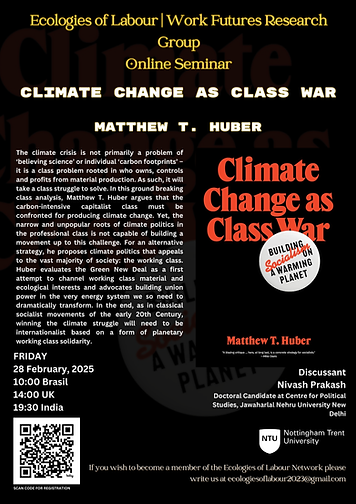
Climate Change as Class War - Book Discussion
FRIDAY
28 February, 2025
10:00 Brasil
14:00 UK
19:30 India
The climate crisis is not primarily a problem of ‘believing science’ or individual ‘carbon footprints’ – it is a class problem rooted in who owns, controls and profits from material production. As such, it will take a class struggle to solve. In this ground breaking class analysis, Matthew T. Huber argues that the carbon-intensive capitalist class must be confronted for producing climate change. Yet, the narrow and unpopular roots of climate politics in the professional class is not capable of building a movement up to this challenge. For an alternative strategy, he proposes climate politics that appeals to the vast majority of society: the working class. Huber evaluates the Green New Deal as a first attempt to channel working class material and ecological interests and advocates building union power in the very energy system we so need to dramatically transform. In the end, as in classical socialist movements of the early 20th Century, winning the climate struggle will need to be internationalist based on a form of planetary working class solidarity.
Authors Bio
Matthew T. Huber is a Professor in the Department of Geography and the Environment at Syracuse University. He is the author of Lifeblood: Oil, Freedom and the Forces of Capital (University of Minnesota Press, 2013) and Climate Change as Class War: Building Socialism on a Warming Climate (Verso Books, 2022).
Seminar Series
Commoning labour, labouring the commons: Making life in common within-against-and-beyond colonial disasters in Puerto Rico
TUESDAY
19 November, 2024
10:30 Brasil
14:30 UK
20:00 India
What are the ecologies of labours that can help us survive and thrive, or exist and re-exist, in the midst of the interlocked global crises of capitalism? Through political-ecological reflections grounded in movement and scholarly spaces in our islands of Puerto Rico and across Latin American and transnational networks, I want to reflect on the multiple interconnected life-work spheres through which communities care for and sustain life in the frontlines of colonial-climate disasters. I attend to diverse self and collective experiences of these labours, from family care to communal kitchens of mutual aid disaster recovery, from mobilizing and alliance-building against social-environmental injustices to creating community economies and energies, from popular education and deliberation encounters to solidarity action-research, from repairing damaged ecosystems to rebuilding houses. These labours-in-common, are enacted together with other keywords that build a coherent framework for praxis –autogestion and mutual aid, communalisms, sovereignty, autonomous and insurgent (body)territories, maroon and abolition ecologies-- in which these labours are re-imagined as a web of life-work for justice as freedom, for stopping the deadly machine of capitalism and repairing the webs of our more-than-human commons, in short, for making a dignified life.
Gustavo García López is an engaged scholar, educator, and apprentice organizer from the islands of Puerto Rico. Combining political ecology with decolonial Latin American and Caribbean studies, his work centers on transformative eco-social initiatives and movements, bridging ideas of commons-making, autogestion, insurgent ecologies, environmental/climate justice movements, and just transitions. He is currently a researcher at the Center for Social Studies, University of Coimbra, where he co-coordinates the Ecology and Society Workshop (ECOSOC). He is a co-founding member of Post-Extractive Futures (a movement facilitation collective), and Undisciplined Environments (a political ecology blog). He lives uprooted from his lands but finding home and guiding stars in his daughter Maia. He is held in life by broad networks of care, of people, spirits, memories, and ecologies.
.png)
Seminar Series
Conflicts in the Middle East and Hamas Attack against Israel on 7th of October 2023 The Palestinian and Syrian Refugees - Integration and Technological Innovation
THURSDAY
12 December, 2024
09:00 Eastern US
11:00 Brasil
14:00 UK
19:30 India
The unprecedented number of Middle Eastern refugees – Palestinian, Syrian, and Lebanese, dominate the news and political agendas globally. Amira Halperin will talk about the stories behind the numbers, the humanitarian crisis, and integration in host countries. She will explore technological innovation and solutions that became pillars in refugee journeys, humanitarian aid, and integration. AI Technologies are being used increasingly in border zones to improve border control and border security. At the same time, there are also digital risks related to hate speech and bias, ethics in AI, and more. Amira will engage the audience with her refugee research, based on fieldwork, in the UK and Canada.
Dr Amira Halperin is a Senior Research Associate at BICOM - Britain Israel
Communications and Research Centre. She is the co - Deputy Editor of BICOM’s Fathom Journal. Amira is media expert of Forum Dvorah (women in foreign policy and national security).
Her areas of expertise are Palestinian affairs, Middle Eastern refugees, media and technology, and terrorism. Her book, ‘The Use of New Media by the Palestinian Diaspora in the United Kingdom’ (Cambridge Scholars Publishing, 2018), is based on pioneering research of the Palestinian Diaspora - UK.
Amira has been working in the UK, Canada, China, and Israel, as a journalist and as a scholar. She has been working with and advising to Non - Governmental Organisations, and the UK and the Canadian Governments.
Amira worked as an Investigative Journalist and as a TV Correspondent for large media organisations, including BBC Television. Dr Amira Halperin holds an MA in International Journalism and a PhD in Communication and Media from the University of Westminster.
She was a lecturer and research fellow at The University of British Columbia. Amira is a Collaborator at The University of British Columbia Centre for Migration Studies.
.png)
Seminar Series
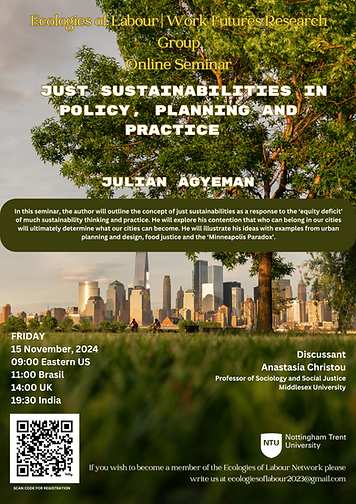
Just sustainabilities in policy, planning and practice
FRIDAY
15 November, 2024
09:00 Eastern US
11:00 Brasil
14:00 UK
19:30 India
In this seminar, the author will outline the concept of just sustainabilities as a response to the ‘equity deficit’ of much sustainability thinking and practice. He will explore his contention that who can belong in our cities will ultimately determine what our cities can become. He will illustrate his ideas with examples from urban planning and design, food justice and the ‘Minneapolis Paradox’.
Julian Agyeman Ph.D. FRSA FRGS is a Professor of Urban and Environmental Policy and Planning at Tufts University. He is the originator of the increasingly influential concept of just sustainabilities, the intentional integration of social justice and environmental sustainability. He centers his research on critical explorations of the complex and embedded relations between humans and the urban environment, whether mediated by governments or social movement organizations, and their effects on public policy and planning processes and outcomes, particularly in relation to notions of justice and equity.
He believes that what our cities can become (sustainable, smart, sharing and resilient) and who is allowed to belong in them (recognition of difference, diversity, and a right to the city) are fundamentally and inextricably interlinked. We must therefore act on both belonging and becoming, together, using just sustainabilities as the anchor, or face deepening spatial and social inequities and inequalities.
He is the author or editor of 13 books, including Just Sustainabilities: Development in an Unequal World (MIT Press, 2003), Cultivating Food Justice: Race, Class and Sustainability (MIT Press, 2011), and Sharing Cities: A Case for Truly Smart and Sustainable Cities (MIT Press, 2015), one of Nature’s Top 20 Books of 2015. In 2018, he was awarded the Athena City Accolade by KTH Royal Institute of Technology, Stockholm, Sweden, for his “outstanding contribution to the field of social justice and ecological sustainability, environmental policy and planning“. On September 1, 2021, he became the Fletcher Professor of Rhetoric and Debate, an endowed chair at Tufts University. In November 2021, he was invited by then Boston Mayor-Elect Michelle Wu to be a Transition Advisor on her Transition Committee. On November 17, 2023, he became Hedersdoktorer (Honorary Doctor) at KTH Royal institute of Technology, Stockholm, Sweden.
For a full biography please visit: https://julianagyeman.com
.png)
Seminar Series
Ecological Labour as an Instrument of Colonization:
My Personal Experience in Occupied Palestine
FRIDAY
25 October, 2024
10:00 Brasil
14:00 UK
18:30 India
“Making the desert green’ is the eternal theme of conquerors,” Hanhan writes in Fugitive Dreams. Born an Arabic-speaking Palestinian in Jerusalem, he grew up in the shadow of this large-scale endeavor called ‘Zionism’, where conquest, population removal, and ethnocide are disguised as ecological progress. Using a combination of readings and photographs, Hanhan illustrates how Palestine’s environment has been severely harmed by a system that rations it for the benefit the newcomers to the land. This destructive ecological segregation is contrasted with the one in his new home – North America.
Ramsey Hanhan is a Palestinian American author. His autobiographical debut, Fugitive Dreams, is a literary exploration of the Palestinian experience through five decades of personal stories. His short stories and poetry have appeared in various publications. He also speaks publicly about Palestine. Ramsey was formerly a physics professor noted for his computer models that describe and predict complexity in nature. He holds a Ph.D. from the University of Michigan and resides near Baltimore, Maryland.
You can find his writings at ramsey-hanhan.medium.com or ramseyhanhan.org.

Seminar Series
Riverine relations, affective labour, and changing environmental subjectivity in Kerala, India
MONDAY
15 July, 2024
10:00 GMT +1 UK
14:30 GMT +5:30 IST
Recent works in political ecology draw attention to affective ecologies that focus on lived experiences and fluid/relational subjectivities. The attention to affect and materiality grounded in vitalist ontology helps imagine new sociological futures and re-envision humanistic notions of agency. In this talk, I build on affective ecology and emotional political ecology literature to demonstrate how people’s subjectivity is transformed through their lived experience of polluted waterscapes, memories of emotional and material engagement with their immediate nature, and affective labor practices to protect their rivers from pollution. Through sociological research con ducted around two environmental protests in Kerala, I provide insights into local communities’ engagement with the changed riverscape. I argue that the formation of environmental subjects does not always occur through environmental discourses and governance techniques, as the environmentality literature suggests. Rather, there are different pathways to environmental subjectification, which include embodied practices and affective labor. For activists involved in Eloor and Kathikudam movements in Kerala, India, their interactions with the river— an immediate nature in both cases— and the memories associated with it act as a central force in the becoming of people who care for the environment.
Sony R K is an independent researcher whose work focuses on nature-society relations, environmentalism, and climate justice. He began studying the ecology of mammals and mountain ungulates and realized the importance of social scientific approaches in understanding conservation action. Hence, he focused on the work of science, legality, and subjectivity in environmentalism for his PhD research. He completed his PhD in Conservation Science and Sustainability Studies from the Ashoka Trust for Research in Ecology and Environment (ATREE) and Manipal Academy of Higher Education (MAHE).
Over the past decade, Sony has associated with various academic institutions and non-governmental organizations. His work over the years spanned diverse themes, including biodiversity mainstreaming in cities and habitat degradation assessment in the western Himalayas, environmental impact assessment, agroecology, regenerative agriculture, and food systems transformation. He also worked as a visiting faculty at the Trans-disciplinary University, Bengaluru, where he designed and taught social science and qualitative research methodology courses.

Seminar Series
Atmospheric Violence: Disaster and Repair in Kashmir
FRIDAY
28 June, 2024
11:30 GMT +1 UK
15:30 GMT +5 PST
16:00 GMT +5:30 IST
How can we think about Kashmir outside of the carceral logics of South Asia? What happens if we center accountability over disciplinary certitude? Can we think from the heart?“Atmospheric Violence” blurs the distinctions between story, theory, and activism. The monograph takes us to the Kashmir of the pahars and is written from the standpoint of those who do not subscribe to the rules by which most others have come to know the world.
Omer Aijazi is a critical disaster studies scholar and decolonial ethnographer of borderland South Asia with long-term commitments in the disputed territory of Kashmir and its continuity with Northern Pakistan. He currently serves as a Lecturer (Assistant Professor) of Disasters and Climate Crisis at the Humanitarian and Conflict Response Institute, University of Manchester.

Seminar Series
Understanding Work at Sea
Thursday
9 May, 2024
14:00 GMT
18:30 IST
Melissa Marschke is a Professor at the School of International Development and Global Studies at the University of Ottawa. Peter Vandergeest is a Professor Emeritus and Senior Scholar in Geography at York University. Both are involved in research projects examining (a) unacceptable working conditions and opportunities for improvement in the seafood sector (b) the role of ‘trash fish’ in seafood supply chains; and (c) if due diligence policies can support labour reforms across the seafood sector.
Abstract: Understanding Work at Sea Oceans have received increasing scholarly attention in recent years, but oceans as a working space have not been a prominent concern in most of this literature. Industrial fish work relies on a mainly migrant labour force, and is notoriously bad in terms of working conditions, living conditions, wages, and access to support organizations and labour justice. In this seminar we present a framework for understanding why working conditions that would be considered unacceptable by most terrestrial employment standards. We highlight two key terms: First, we use the lens of racial capitalism to show how low wages and long hours of work have become structured into industrial fishing through increasing employment of migrant workers from Southeast Asia and Africa. Second, we draw on governance approaches to show how workers in industrial fishing vessels that operate outside the national (flag state) exclusive economic zones are in a dynamic and confusing socio-legal situation that renders their formal and substantive rights subject to overlapping and unclear jurisdictions, regulations, and practices—a situation of jurisdictional in-betweenness. Jurisdictional ambiguity specific to ocean governance enables the process of lowering the cost of labour through intensive exploitation of racialized migrant workers. We illustrate these themes with fisheries operating out of East Asia, that draw on migrant labour from Indonesia and the Philippines, and may offload or do dock repairs in Cape Town, South Africa.

Seminar Series
Connecting extraction of soil for bricks to the everyday social reproduction of brick kiln workers in India
11 April, 2024
14:00 GMT
18:30 IST
Pratik Mishra is a geographer whose research seeks to draw strong connections between the fields of labour studies, political ecology and urban studies. His PhD research from King's College London looked at the everyday politics of labour within a brick kiln cluster on the outskirts of Delhi, delving into questions of informal labour regimes, circular migration, and agrarian futures. He was also a Post-Doctoral Researcher at Lancaster University where his research draws connections accross labour. caste, coloniality, and urban infrastructure in relation to the history of manual scavenging in South Asia. His research has ben published in several journals inclusing Focaal, Urbanisation, SAMAJ and EPW. He is also engaged in a film-making project around the life-worlds of brick kiln workers.
%20(1).png)
Seminar Series
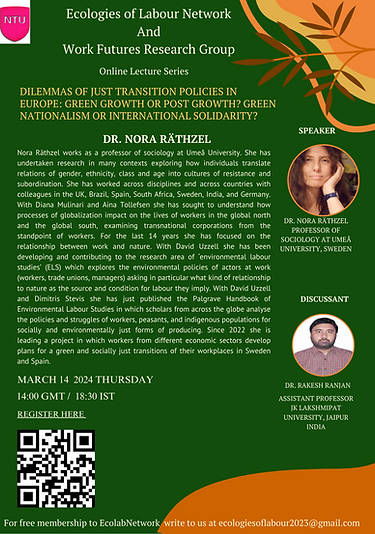
Dilemmas of Just Transition Policies in Europe: Green Growth or Post-Growth? Green Nationalism of International Solidarity?
14 March, 2024
14:00 GMT
18:30 IST
Nora Räthzel works as a professor of sociology at Umeâ University. She has undertaken research in many contexts exploring how individuals translate relations of gender, ethnicity, class and age into cultures of resistance and subordination. She has worked across disciplines and across countries with colleagues in the UK, Brazil, Spain, South Africa, Sweden, India and Germany. With Diana Mulinari and Aina Tollefsen she has sought to understand how processes of globalization impact on the lives of workers in the global north and the global south, examining transnational corporations from the standpoint of workers. For the last 14 years she has focused on the relationship between work and nature. With David Uzzell she has been developing and contributing to the research area of ‘environmental labour studies’ (ELS) which explores the environmental policies of actors at work (workers, trade unions, managers) asking in particular what kind of relationship to nature as the source and condition for labour they imply. With David Uzzell and Dimitris Stevis she has just published the Palgrave Handbook of Environmental Labour Studies in which scholars from across the globe analyse the policies and struggles of workers, peasants, and indigenous populations for socially and environmentally just forms of producing. Since 2022 she is leading a project in which workers from different economic sectors develop plans for a green and socially just transition of their workplaces in Sweden and Spain.
.png)
Seminar Series
Children, Cows and Common Bracken at Work
29 February, 2024
14:00 GMT
18:30 IST
Barbara Turk Niskač holds a PhD in Ethnology, Cultural and Social Anthropology from the University of Ljubljana, Slovenia. She is currently Marie Curie research fellow at the Faculty of Education and Culture, Tampere University, Finland. Her main research interests lie at the intersection of the anthropology of childhood, anthropology of work, visual studies, and environmental and multispecies ethnography.
Abstract: This presentation explores multispecies relationality on unique patches of land in South-Eastern Slovenia, called Steljniki. These distinctive land formations feature expanses of common bracken interspersed with sparsely populated silver birch trees. Traditionally, they have been used for livestock grazing in spring and the harvesting of bracken in autumn. By tracing the transformation of these areas from active farmland to abandoned landscapes, I emphasise the shared agency of humans, grazing animals and bracken. Along the soil, they played a co-constitutive role in the creation, maintenance and transformation of Steljniki. Within multispecies assemblages, special attention is given to children´s experiences as grazing cows was typically children´s obligation, and they have for generations participated in work related to land cultivation in subsistence-oriented farming tasks. Additionally, the abandonment of Steljniki offers insights into the entanglements of the economy and human and more-than-human lives. In this sense, work is recognized as a central activity which places people in the socialworld of other living things (Tsing 2013: 35).

Seminar Series
Workers of the Earth - Labour, Ecology and Reproduction in the Age of Climate Change
19 January, 2024
14:00 GMT
18:30 IST
Stefania Barca is Distinguished Researcher "Beatriz Galindo" at the University of Santiago de Compostela, where she teaches Contemporary, Environmental and Gender History. She investigates the political ecology of labour in the industrial era from a feminist perspective. She is the author of Forces of Reproduction: Notes for a counterhegemonic Anthropocene (Cambridge University Press, 2020), and is currently working on a new book titled Workers of the Earth: Labour, ecology and reproduction in the age of climate change (forthcoming from Pluto Press).

Seminar Series was organized from January 2024 to May 2024 by Bhavna Harchandani.
From May 2024 to 2025 it was co-organized by Anjana Rajagopalan and Joana Sá Couto.
The Seminar Series is organized by Joana Sá Couto since.
NEWS
Ecologies of Labour Network at the Political Ecology Network POLLEN Conference 2026, in Barcelona!

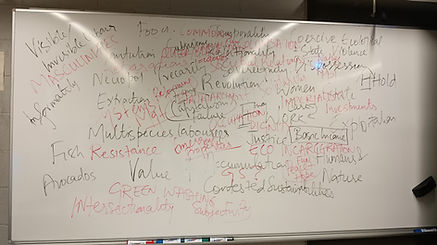
Members and co-founders of the Ecologies of Labour Network, Afreen Faridi and Joana Sá Couto, represented the network at the Political Ecology Network (POLLEN) 2026 conference by convening the panel "Ecology and Social Reproduction for a Just and Dignified Future."
Held at the Facultat de Geografia i Història (UB-219) on 29 June 2026, the hybrid panel brought together an outstanding group of scholars whose high-quality contributions fostered a rich and engaging dialogue across diverse contexts and research perspectives.
The panel explored labour as a set of practices, both waged and unwaged, through which humans interact with the environment. Drawing on political ecology, the discussions examined the relationships that labour cultivates between humans, more-than-humans, land, sea, and other elements of the natural world. By bringing together questions of labour, dignity, sustainability, and social reproduction, the panel highlighted the importance of using academic spaces to amplify grassroots perspectives on environmental degradation, resistance, and social justice.
The Ecologies of Labour Network is grateful to all presenters and participants for their insightful contributions and for making the panel such a stimulating and collaborative space for discussion.
More on the conference and the network: https://pollenpoliticalecology.network/
Papers
Session 1
Two forms of labour in the P’urhépecha Plateau: the avocado industry and the community of Cherán
Francisco Javier Montano Cruz (Karlsruhe Institute of Tecnology)
Care on the croft: From affective encounters to ecosocial reproduction
Esther Kaner (UCL)
Starting a Revolution in the Garden? Challenges and mediation in Permaculture Care Practices
Franziska Ohde (Goethe University Frankfurt)
Ecologies of Extraction: Labour Exploitation and Politics of Accumulation in Chhattisgarh’s Sponge Iron Frontier
Rashi Agrawal (Jawaharlal Nehru University)
Session 2 Monday 29 June
Fish economy: an invisible economy of care
Merlyn Antony (Dr. B.R. Ambedkar University Delhi)
Desafíos socioecológicos en la Ría de Arousa: sostenibilidades en disputa entre el marisqueo y el extractivismo verde.
Saila Vilar (Universitat de Barcelona)
When the sea is no longer enough: Fishing precarity and reorganisation of reproductive work in fishing households in northern Peru
Nicola Espinosa Anaya (Pontificia Universidad Católica del Perú (PUCP))
When global capitalism meets local patriarchy: Gendered division of labour in small-scale fisheries during renewable energy transitions in Yemen’s conflict Ekatherina Zhukova (Karlstad University)
Thorstein Veblen in Retrospect and Prospect: Can the Basic Income Truly Act as a Trigger to Self-Organise a New Resilient System of Food Community?
Mu-Jeong Kho (University College London (UCL), UK)

Are you a part of the Network? Would you like to share a new experience, publication or event? Please, feel free to reach out.